
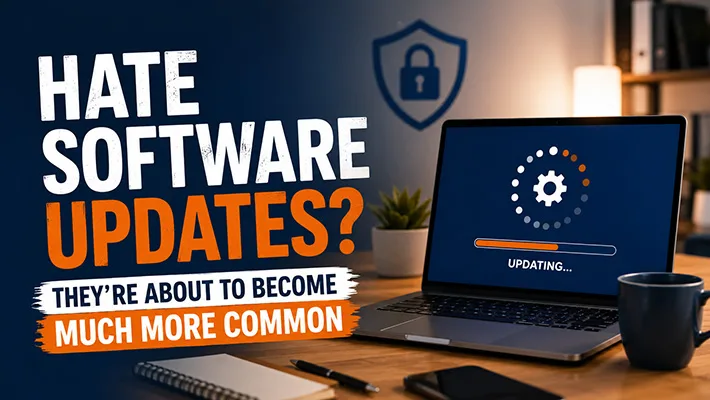
We’ve all been there. You’re in the middle of something and a notification pops up: “Updates are ready to install.” You click “Remind me later.” Again.
It’s one of the most common things business owners say: updates are annoying, they interrupt the working day, and nothing ever seems to go wrong if you skip them. So why bother?
Here’s why that thinking is about to become more dangerous than ever.
The government has issued a warning
Last month, the National Cyber Security Centre (the NCSC, part of GCHQ) published a blog warning that we are heading towards what they’re calling a “vulnerability patch wave”. In plain English: a surge of urgent software updates, arriving faster than most businesses are used to, that will need to be applied quickly.
Their reasoning? Artificial intelligence is now being used by criminals and hostile actors to find weaknesses in software at a scale and speed that wasn’t possible before. Decades of shortcuts taken by software developers are being exposed all at once, and the fixes are coming thick and fast. The NCSC’s message is clear: organisations of all sizes need to be ready.
Why updates matter more than most people realise
Every piece of software, whether it’s Windows, your accounting package, your email app, or the router sitting in the corner of your office, can contain weaknesses. Developers find these weaknesses over time and release updates to fix them. When you delay or ignore those updates, you leave the door open.
Criminals know this. In fact, one of the most common ways businesses get attacked is through software that simply hasn’t been kept up to date. It’s not sophisticated. It’s opportunistic. Attackers scan the internet looking for businesses running older, unprotected versions of common software, and they walk straight in.
The NCSC is warning that the volume of these fixes is about to increase significantly. That means the window between a weakness being discovered and criminals trying to exploit it is getting shorter. Keeping on top of updates is no longer something you can afford to put off.
What does “keeping on top of updates” actually mean?
For a small business, it roughly means:
- Your computers and laptops should be set to update automatically wherever possible, and those updates should be applied, not deferred indefinitely.
- Your other devices such as printers, network equipment, and anything else connected to the internet need to be checked and updated too. These are often forgotten entirely.
- Your software and apps need the same attention, not just your operating system.
- Anything old that can no longer receive updates is a risk. If it’s connected to the internet, it needs to be replaced or isolated.
The NCSC also recommends that where an update is available and is flagged as critical, it should be applied as quickly as possible. Not next week. Not after the busy period. Now.
The honest truth about “nothing has gone wrong yet”
This is the bit most business owners find uncomfortable. The reason nothing has gone wrong yet is usually luck, not good practice.
Small business owners often assume they are too small to be a target. The reality is that most attacks on small businesses are not targeted at all. They are automated. A criminal doesn’t sit at a keyboard and choose a specific business. A piece of software scans thousands of businesses at once and flags the ones that look easy. Being small offers no protection whatsoever.
The good news is that keeping devices and software up to date is one of the most effective things a business can do to stop those automated attacks from finding a way in. It is not complicated. It is not expensive. It is just a habit, and one worth forming before the patch wave arrives.
Not sure where you stand?
If you don’t have a clear picture of what devices your team are using, whether they’re up to date, or who’s responsible for making sure they stay that way, you’re not alone. Most small businesses don’t, until something goes wrong.
We can put systems in place to make sure all of your devices are kept up to date automatically, with no disruption to your working day, and with someone keeping an eye on things so you don’t have to.
If you’d like a straightforward conversation about where your business stands, book a call here. No obligation, no sales pitch, just a sensible chat.